
If you are researching wide-format print technologies, one of the most important questions is whether latex or eco-solvent printing offers the better long-term investment.
Both technologies are widely used for vehicle wraps, decals, banners, retail graphics, wallcoverings, and signage. Nevertheless, they differ significantly in production speed, maintenance requirements, media flexibility, durability, operating environment, and overall shop efficiency.
As customer expectations continue to rise, faster turnaround times, broader application capabilities, and reduced downtime matter more than ever. For this reason, many print providers are increasingly moving toward latex printing technology for modern production environments.
To help you evaluate the best fit for your operation, this guide breaks down the key differences between latex and eco-solvent printing. It will help you determine which technology best supports your applications, customers, production needs, and long-term business goals.
Why More Print Shops Are Comparing Latex and Eco-Solvent Printing
Wide-format printing has become more demanding than ever. Today, customers expect faster turnaround times, broader application capabilities, and consistent quality across everything from vehicle wraps to interior graphics.
As a result, many print providers are reevaluating traditional eco-solvent production and considering whether latex printing offers a stronger long-term solution for speed, flexibility, and overall shop efficiency.
What Is Latex Printing?
Latex printing uses water-based ink technology designed for wide format graphics, signage, wraps, wallpaper, retail displays, and interior décor applications.
In particular, modern latex printers are known for:
- Immediate dry times
- Same-day lamination
- Broad media compatibility
- Low-odor printing
- Strong scratch resistance
- Consistent color output
- High production flexibility
Over the past decade, latex technology has advanced significantly in speed, reliability, color performance, and application versatility. As a result, it is now widely used by:
- Vehicle wrap shops
- Sign companies
- Retail graphics providers
- Commercial print environments
- Interior décor producers
- Educational and healthcare graphics
Because prints come out dry and ready for finishing, latex technology can help shops reduce delays, expand into new applications, and maintain a more efficient production workflow.
What Is Eco-Solvent Printing?
Eco-solvent printers use solvent-based inks designed primarily for durable outdoor graphics and adhesive vinyl applications.
Traditionally, eco-solvent technology has long been popular for:
- Vehicle graphics
- Outdoor signage
- Banners
- Decals
- Stickers
Because of its established history and reliable performance on vinyl-based media, eco-solvent equipment remains common in traditional sign and vehicle wrap shops.
However, compared with modern latex systems, eco-solvent production may require longer finishing times, additional maintenance, and greater consideration for ventilation and the overall production environment.
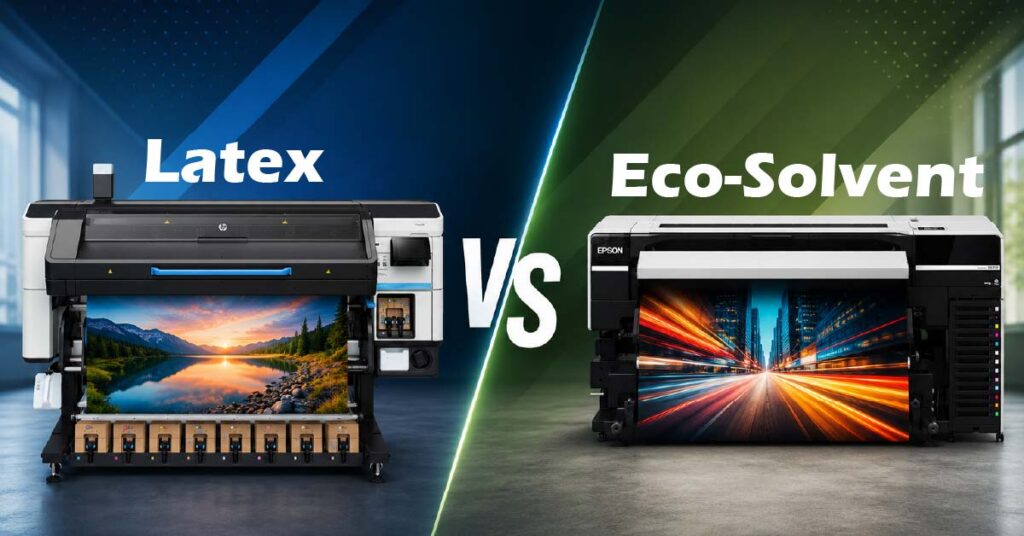
Quick Comparison: Latex vs Eco-Solvent Printing
| Feature | Latex Printing | Eco-Solvent Printing |
|---|---|---|
| Dry Time | Immediate | Requires outgassing |
| Lamination | Same-day capable | Often 24-48 hour wait |
| Odor | Low odor | Noticeable solvent smell |
| Indoor Suitability | Excellent | Limited in sensitive environments |
| Media Compatibility | Very broad | Primarily vinyl and banner focused |
| Maintenance | Lower operator intervention | More frequent maintenance |
| Printhead Replacement | User replaceable on many systems | Often service-intensive |
| Scratch Resistance | Strong on many applications | Lamination commonly required |
| Production Flexibility | High | Moderate |
| Shop Efficiency | Excellent for fast turnaround | Slower finishing workflow |
Overall, latex printing offers stronger advantages in turnaround time, indoor suitability, media flexibility, and workflow efficiency. However, eco-solvent printing remains a proven option for traditional vinyl, signage, and wrap applications.
Production Speed and Turnaround Time
Production speed is no longer measured by print speed alone. Finishing speed is equally important because delays after printing can slow the entire workflow.
For example, one of the primary limitations of eco-solvent printing is the outgassing period. Before lamination, eco-solvent graphics often need 24 to 48 hours for solvents to evaporate properly. Laminating too soon can lead to bubbling, adhesion issues, or premature graphic failure.
By comparison, latex prints come out dry and ready for:
- Lamination
- Contour cutting
- Packaging
- Installation
- Shipping
As a result, many print shops can complete jobs the same day instead of waiting several days before finishing and delivery.
In particular, this faster workflow benefits shops handling:
- Fleet graphics
- Retail rollouts
- Trade show graphics
- Event signage
- Short-deadline wrap projects
For these high-pressure applications, latex printing can provide a major operational advantage by reducing finishing delays, improving job throughput, and supporting more consistent turnaround times.
Media Compatibility and Application Range
Modern print shops are expected to produce far more than banners and vinyl decals. For example, today’s customers increasingly request:
- Wall murals
- Textile graphics
- Window graphics
- Interior décor
- Educational graphics
- Retail displays
- Temporary event graphics
As a Result, to meet these evolving demands, latex printers can support a wide range of materials, including:
- Vinyl
- Banner media
- Textiles
- Wallpaper
- Canvas
- Polypropylene
- Window films
- Uncoated papers
Meanwhile, eco-solvent printers continue to perform well on traditional adhesive vinyl and banner applications. However, latex technology often provides greater flexibility for shops seeking to diversify into interior graphics, décor, textiles, and other specialty applications.
As a result, print providers can expand their service offerings, pursue new markets, and produce a broader range of applications without investing in multiple printing technologies.
Maintenance and Downtime
Maintenance requirements can directly affect profitability, production capacity, and delivery performance. For instance, eco-solvent printers often require:
- More cleaning cycles
- Additional maintenance attention
- Longer recovery periods after sitting idle
- More service-related downtime
In contrast, latex printers have improved significantly in reliability and automation in recent years. Many modern latex systems now feature:
- Automated maintenance routines
- User-replaceable printheads
- Reduced manual intervention
- Consistent nozzle compensation systems
As a result, operators can often spend less time maintaining the printer and more time producing customer work.
Ultimately, reducing downtime can increase job capacity, improve turnaround consistency, and support higher levels of customer satisfaction.
Print Quality and Durability
Both latex and eco-solvent technologies are capable of producing professional-quality graphics with vibrant color output. However, modern latex technology has made major advances in:
- Color consistency
- Smooth gradients
- Scratch resistance
- Media versatility
- Long-run reliability
Overall, both technologies can deliver comparable outdoor durability when paired with quality media and appropriate laminates.
Even so, latex inks often provide stronger scratch resistance during:
- Finishing
- Shipping
- Installation
- Handling
As a result, some short-term graphics may not require lamination, helping shops reduce material costs, finishing time, and production delays.
Shop Environment and Indoor Printing
Additionally, shop environment matters more today than ever before. For example, many businesses now operate in:
- Shared production facilities
- Retail environments
- Office spaces
- Schools
- Healthcare facilities
Because latex printers use water-based ink technology, they typically produce lower odor output than solvent-based systems. As a result, latex printing can be a strong fit for customer-facing and indoor-sensitive environments.
Compared to, eco-solvent printers may require:
- Additional ventilation
- Dedicated print areas
- Greater environmental management
For these reasons, latex technology is often the preferred solution for businesses that prioritize indoor air quality, workplace comfort, and greater installation flexibility.
Operating Costs and Efficiency
First, the true cost of a printer goes far beyond ink pricing. Therefore, when comparing technologies, shops should evaluate:
- Downtime
- Labor requirements
- Ink waste
- Maintenance frequency
- Printhead replacement
- Finishing delays
- Energy usage
- Production bottlenecks
Although, eco-solvent systems may sometimes appear less expensive upfront, slower finishing timelines and additional maintenance can reduce operational efficiency over time.
By comparison, latex printing helps many shops improve:
- Production speed
- Labor utilization
- Turnaround consistency
- Job throughput
- Same-day delivery capability
Ultimately, for modern production environments, operational efficiency often creates more long-term value than choosing the lowest-cost hardware.
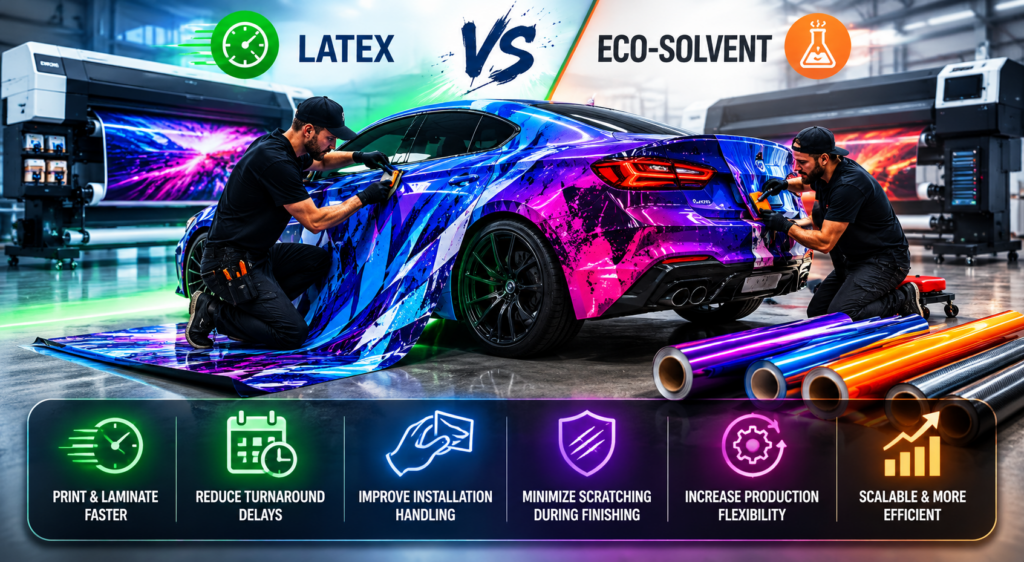
Which Technology Is Better for Vehicle Wraps?
Latex and eco-solvent technologies are both widely used for professional vehicle graphics and wraps. However, the better choice often depends on production volume, turnaround expectations, finishing requirements, and growth plans.
That said, latex printing continues to gain momentum because it allows shops to:
- Print and laminate faster
- Reduce turnaround delays
- Improve installation handling
- Minimize scratching during finishing
- Increase production flexibility
- Move jobs through production more efficiently
In particular, latex systems can benefit wrap shops managing tight deadlines, fleet projects, and multiple daily installations. Because prints come out dry and ready for finishing, operators can move directly into lamination, cutting, packaging, or installation.
As a result, shops can reduce bottlenecks, improve turnaround consistency, and complete more work within the same schedule. In addition, faster finishing makes it easier to handle last-minute requests and replacement panels.
Ultimately, many growing wrap providers are moving toward latex for greater scalability, faster production, broader application flexibility, and improved workflow efficiency.
Final Thoughts: Is Latex Better Than Eco-Solvent?
In conclusion, eco-solvent printing still has a place in the wide format industry, especially for traditional signage and wrap production. However, modern print environments demand more speed, flexibility, and efficiency than ever before.
For this reason, latex printing has become the stronger long-term solution for many print providers because it delivers:
- Immediate finishing capability
- Broader application support
- Lower odor operation
- Reduced downtime
- Improved workflow efficiency
- Greater production flexibility
Ultimately, latex printing is often the better overall investment for shops looking to expand applications, shorten turnaround times, improve productivity, and modernize production capabilities.
Even so, the best way to compare technologies is through real-world testing using your own files, media, and production requirements.
In short, if your goal is faster production, broader application capability, and a more scalable print environment, latex printing is likely the better choice for your business.
Frequently Asked Questions
Overall, latex printing offers a stronger overall production advantage. It supports faster turnaround times, same-day lamination, low-odor output, broad media compatibility, and efficient day-to-day operation. However, eco-solvent printers remain a capable and established option for traditional signage, decals, and vehicle wrap production.
In practice, both technologies are successfully used for vehicle wraps. Latex printing offers faster finishing, strong scratch resistance, and the ability to laminate prints immediately. In comparison, eco-solvent printing has a long-established history in the vehicle wrap industry and remains widely used by many experienced wrap providers.
Without lamination, eco-solvent graphics may be more susceptible to scratching during handling, finishing, or installation, particularly when they are not laminated. By comparison, many latex ink systems include strong scratch-resistance characteristics that can improve durability across a variety of applications. Lamination may still be recommended for demanding or long-term installations.
Because, latex printers use water-based ink technology and generally produce lower odor output than solvent-based systems. As a result, many businesses select latex technology for indoor-sensitive applications, customer-facing environments, and sustainability-focused production goals.
Eco-solvent printers can produce noticeable solvent odors and emissions. Therefore, some production environments may require additional airflow, ventilation, or a dedicated printing area. Requirements can vary by printer model, ink formulation, facility layout, and applicable workplace regulations.
In general, many print providers are moving toward latex technology because it can offer:
Faster production and finishing
Same-day lamination
Lower routine maintenance
Greater media versatility
Low-odor printing
Improved workflow and operational efficiency
Together, these advantages can help growing print shops expand their applications and complete more work within the same production schedule.