
White ink printing is one of the most effective ways to expand your wide format capabilities and unlock higher-value applications. It allows you to print vibrant graphics on dark, clear, and specialty materials that traditional CMYK printing cannot handle effectively.
If you are looking to differentiate your print offering, improve turnaround times, and increase margins, white ink printing is a strategic investment worth evaluating.
What Is White Ink Printing?
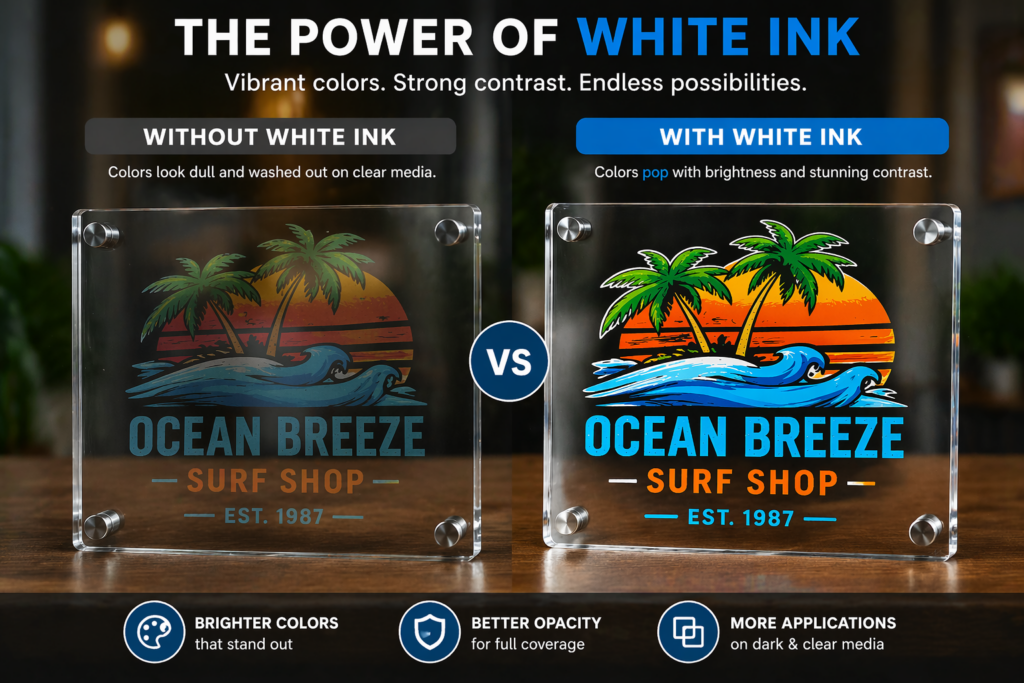
White ink printing uses opaque white ink to create a solid base layer beneath color or as a standalone graphic element. Standard inks are not fully opaque, so they often appear dull on dark or transparent materials.
White ink solves this problem by creating a bright foundation that enhances color accuracy and visibility. As a result, your prints look sharper, more vibrant, and more professional across a wider range of substrates.
Why White Ink Printing Matters
White ink expands what your business can produce. Instead of being limited to white media, you can print directly onto:
- Dark-colored materials
- Clear films and acrylic
- Metallic and specialty substrates
Because of this flexibility, you can take on projects that many competitors cannot produce in-house.
In addition, customers are often willing to pay more for these specialty applications, which improves your overall profitability.
Common Applications for White Ink Printing
White ink is used in a wide range of high-impact applications, including:
- Window graphics and decals
- Backlit displays and lightboxes
- Packaging mockups
- Retail signage on dark substrates
- Two-way window graphics
- Privacy films and decorative glass
These applications are often considered premium, which makes them ideal for increasing revenue per job.
White Ink Printing Methods Explained
There are several ways to use white ink, depending on the application.
Spot Color
This is the simplest method. White ink is printed either alone or in selected areas alongside color.
Underprinting
White ink is printed first as a base layer. Color is then printed on top. This ensures colors remain vibrant on dark materials.
Overprinting
This method is used for clear materials. The image is printed in reverse, then backed with white ink to enhance visibility and light diffusion.
Dual-View Printing
This technique allows different images to be viewed from each side of a material. A layer of white ink separates the two designs.
Each method creates new opportunities to produce premium, specialty graphics.
How White Ink Improves Production Efficiency
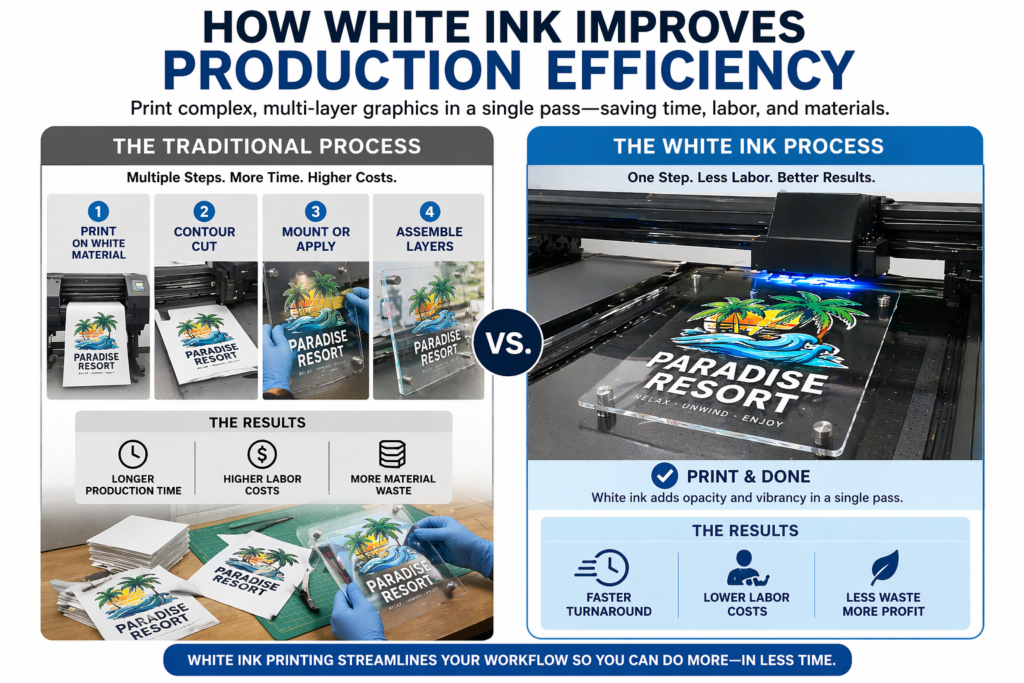
Many print providers manually assemble layered graphics using multiple materials. This process takes time and increases labor costs.
White ink printing eliminates many of these steps by allowing you to:
- Print directly onto final substrates
- Reduce material waste
- Minimize manual assembly
- Speed up production time
As a result, you can complete jobs faster while maintaining consistent quality.
Business Growth Opportunities with White Ink
Adding white ink capability allows you to enter new markets and expand your service offering.
For example, you can produce:
- High-end packaging prototypes
- Retail and POP displays
- Specialty signage
- Interior décor applications
This capability also makes your business more attractive to customers who want unique and customized print solutions.
White Ink Printing Pros and Considerations
Advantages
- Expands application range
- Improves color on dark and clear media
- Enables premium, high-margin products
- Reduces production steps
Considerations
- Higher ink and equipment cost
- Maintenance requirements for some technologies
- Shorter shelf life compared to standard inks
Understanding these factors helps you determine whether white ink aligns with your business model.
Latex vs Eco-Solvent vs UV White Ink
White ink performance and maintenance vary by technology.
Eco-Solvent and UV Systems
These systems often use titanium dioxide-based ink. While effective, the ink can settle over time. This requires regular agitation and maintenance to prevent clogging.
Latex Systems
Modern latex printers from companies like HP have significantly improved white ink performance.
Key advantages include:
- Automatic ink circulation
- Reduced maintenance requirements
- No hazardous air pollutants
- Consistent, high-opacity white output
Additionally, solutions from Epson continue to expand white ink capabilities across multiple print segments.
Because of these advancements, latex technology has become a preferred option for many print providers.
Is White Ink Printing Worth the Investment?
White ink printing can deliver strong returns when there is consistent demand for specialty applications.
You should consider investing if:
- You frequently produce layered or complex graphics
- Customers request printing on dark or clear materials
- You want to expand into higher-margin applications
If demand is limited, outsourcing may be the better short-term strategy.
However, as customer expectations continue to evolve, having white ink capability can position your business for long-term growth.
Final Thoughts
White ink printing is no longer a niche capability. It is a strategic advantage for print providers looking to stand out in a competitive market.
By expanding your application range, improving production efficiency, and enabling premium output, white ink can play a key role in growing your business.
Expand Your Capabilities with White Ink Printing
Talk with a printing specialist to evaluate the right white ink solution for your applications and growth goals. Talk to a specialist today.