
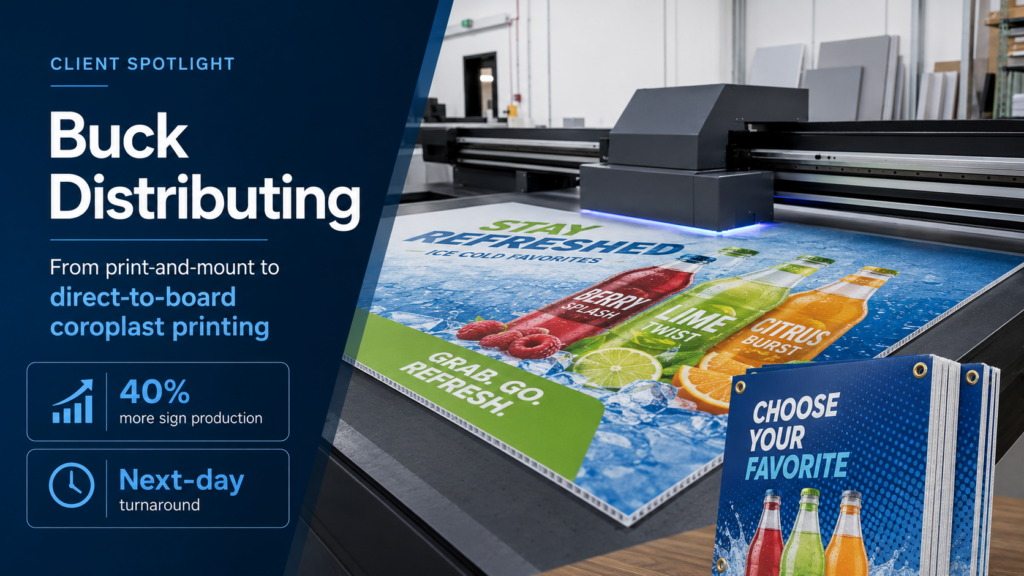
Client Spotlight: Buck Distributing. Moving from print-and-mount to direct-to-board flatbed printing on coroplast.
Buck Distributing eliminated its print-and-mount workflow, retired its mounting and laminating step, and increased sign production by 40 percent in two years by adding a flatbed printer that prints directly to corrugated plastic. That is beverage distributor flatbed printing in practice, and it is less exotic than it sounds. The distributor’s in-house sign shop had been printing on adhesive vinyl and hand-mounting it to coroplast sheets. Printing direct-to-board removed the vinyl, the laminate, the mounting labor, and several days from turnaround time.
This is a look at what actually changed in that shop, where the money came from, and how the same job would be built on current equipment.
This is a look at what actually changed in that shop, where the money came from, and how the same job would be built on current equipment.
Results at a glance
| Metric | Before | After |
| Signage requiring mounting to coroplast | About 70 percent of total signage | Printed direct to board |
| Mounting labor | One part-time employee dedicated to mounting | Position eliminated |
| Finishing equipment in the workflow | Mounting and laminating machines | Removed from the sign workflow |
| Typical turnaround on a sign job | Three to four days | Next day |
| Sign production over two years | Baseline | Up 40 percent |
| Print time, 4 x 8 foot sheet | Print, laminate, mount, trim | About six minutes on the flatbed |
Figures as reported by Buck Distributing. See the verification notes at the end of this document.
About Buck Distributing
Buck Distributing is a family-owned beverage wholesaler serving a ten-county territory east of Washington, DC, in Maryland. The company employs roughly 100 people, including 21 salespeople, and distributes Miller, Yuengling, and local craft brands to supermarkets, liquor stores, bars, restaurants, and other licensed retailers.
Like most distributors, Buck supplies its retail accounts with free point-of-purchase materials: posters, banners, decals, case cards, and shelf signage, customized per account. That program is a sales tool, not a side project. When a retailer asks for a display sign for a weekend promotion, the sign either arrives in time to sell beer or it does not. That combination of steady volume and short deadlines is what makes beverage distributor flatbed printing worth evaluating, because the cost of every sign lands on your own P&L rather than a customer’s.
Mark Jones, Merchandising and Sales Support Manager, runs that program.
The problem: a print-and-mount workflow that could not keep up
Buck’s sign shop was fielding 200 to 400 sign requests per week and consuming roughly 2,000 sheets of 4 x 8 foot corrugated plastic per year.
The workflow was standard for the time. Two HP Latex L25500 roll-to-roll printers produced graphics on adhesive-backed vinyl. Someone then laminated the print, mounted it to a coroplast sheet, and trimmed it.
“Seventy percent of our total signage was printed and mounted to coroplast. We hired a part-time employee whose only responsibility was mounting signage.”
— Mark Jones, Merchandising and Sales Support Manager, Buck Distributing
That is the part buyers underestimate. The cost of a mounted coroplast sign is not the board. It is the vinyl, the laminate, the adhesive, the labor minutes per sheet, the bubbles and re-dos, and the queue that builds behind a single-station manual process.
Why they waited on flatbed
Jones and his sign shop manager had been watching flatbed printers at regional sign and graphics trade shows for years.
“We believed the flatbed printer was the way to go, but we both agreed the technology and price point weren’t there yet.”
That patience is reasonable. Flatbed and hybrid printers were, for a long time, a large-shop purchase. What changed was the arrival of 64-inch machines that print rigid board and roll media on a single footprint, run on standard shop power, and land at a price an in-house department can justify against its own labor and material spend.
The change: printing direct to board
Buck purchased an HP FB550 flatbed printer to work alongside the existing latex roll-to-roll fleet. The machine prints directly onto rigid sheet goods with durable, weather-resistant ink, which removes the vinyl and the mounting step entirely.
“It’s definitely impressive. It’s amazing how many more signs we produce now than we were printing two or three years ago. The FB550 will print a 4-by-8-foot sheet in approximately six minutes.”
The productivity gain came from two places, and only one of them is print speed.
- Print speed. A 4 x 8 sheet in roughly six minutes.
- Overlapped loading. The flatbed lets an operator load one sheet, print another, and offload a finished one in the same cycle. One person keeps the machine fed continuously instead of babysitting a single job through four stations.
Together those changes let Buck retire its mounting and laminating machines from the sign workflow and eliminate one part-time position.
Where the savings actually showed up
Labor and materials on every mounted sign
Every direct-to-board sign removed a layer of adhesive vinyl, a layer of laminate, and several minutes of manual mounting. Across 2,000 sheets a year, that is the whole business case.
Replacing vinyl banners with double-sided coroplast
This was the savings Buck did not plan on. The team began replacing traditional vinyl banners with printed coroplast signs.
“We print double-sided on the coroplast and put grommets in each corner for hanging. We’ve found that these signs last a lot longer than regular banners and don’t need to be replaced or changed as often.”
Fewer replacement cycles is a recurring saving, not a one-time one. For a distributor placing signage in hundreds of retail environments, replacement frequency is a real line item.
Turnaround as a sales advantage
“Our salespeople are definitely reaping the benefits with our new-found productivity. Jobs that typically took three to four days to complete can now be out the door to the customer next day.”
For a beverage distributor, that is competitive ground. Next-day signage means a rep can respond to a retailer’s promotion, a competitor’s endcap, or a local event inside the same week.
The versatility nobody budgets for: roll-to-roll on the same machine
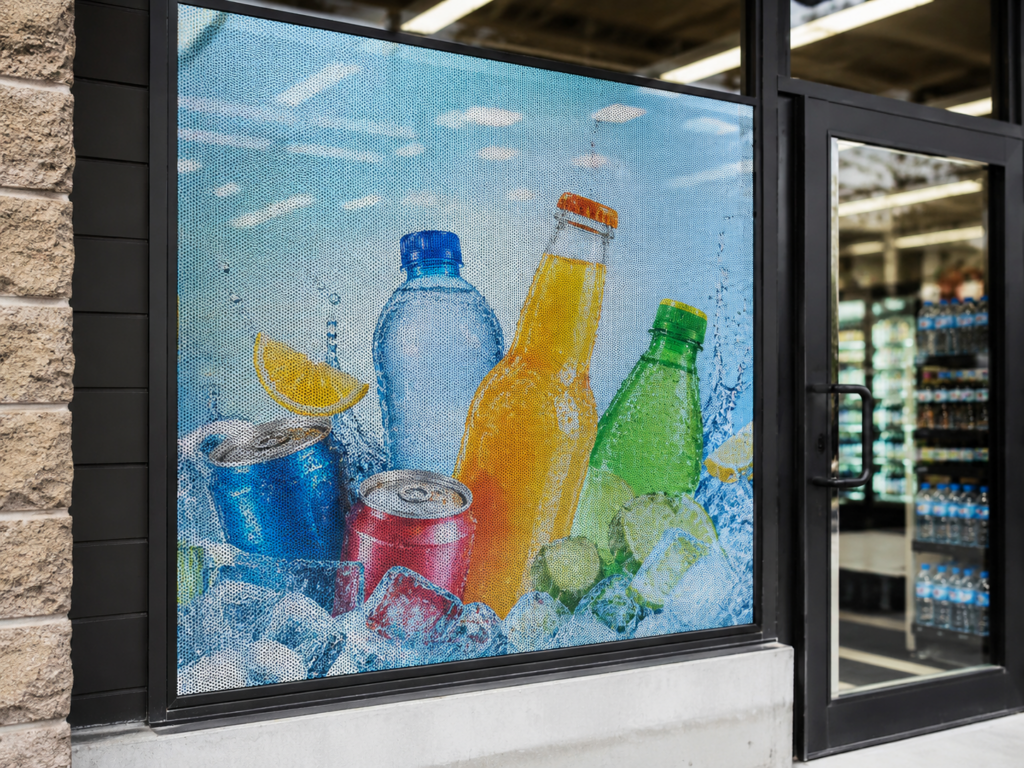
Before the flatbed arrived, everything ran on the two L25500 latex printers: adhesive vinyl, polypropylene for posters, scrim vinyl for banners, and perforated vinyl for window graphics.
The hybrid roll-to-roll capability on the flatbed let Buck move some of that work over and balance the load between machines.
“Because you can leave the banner material loaded on the roll-to-roll, you just remove the tables and run your banner and window perf jobs. You can alternate between coroplast and roll-to-roll very easily.”
One unexpected result involved window perforated vinyl. Jones explains that printing perf on the flatbed lays the ink down a little thicker. The perf comes off the machine stiffer and easier to apply.
“Our salespeople now ask us to print the perf on the 550 because it’s easier to install.”
That detail matters more than it sounds. In a distributor’s world, the person installing the graphic is often a salesperson in a store aisle, not a trained installer. Any change that makes a window graphic go up faster and cleaner reduces failed installs and callbacks.
The outcome
Over two years, Buck increased sign production by 40 percent using the flatbed and the latex roll-to-roll fleet together. Volume grew enough that the company added an HP Latex 570 roll-to-roll printer to absorb the additional orders.
“We really like the savings on ink that we get from using the 3-liter cartridges for both the FB550 and Latex 570.”
Larger ink containers are one of the least discussed cost levers in wide-format production. Cost per liter typically drops as container size increases, and a shop running high daily volume spends less time on cartridge changes and less on shipping and packaging waste.
How this workflow is built today
The FB550 has since been discontinued. If you are evaluating the same move now, here is the current equivalent of what Buck built.
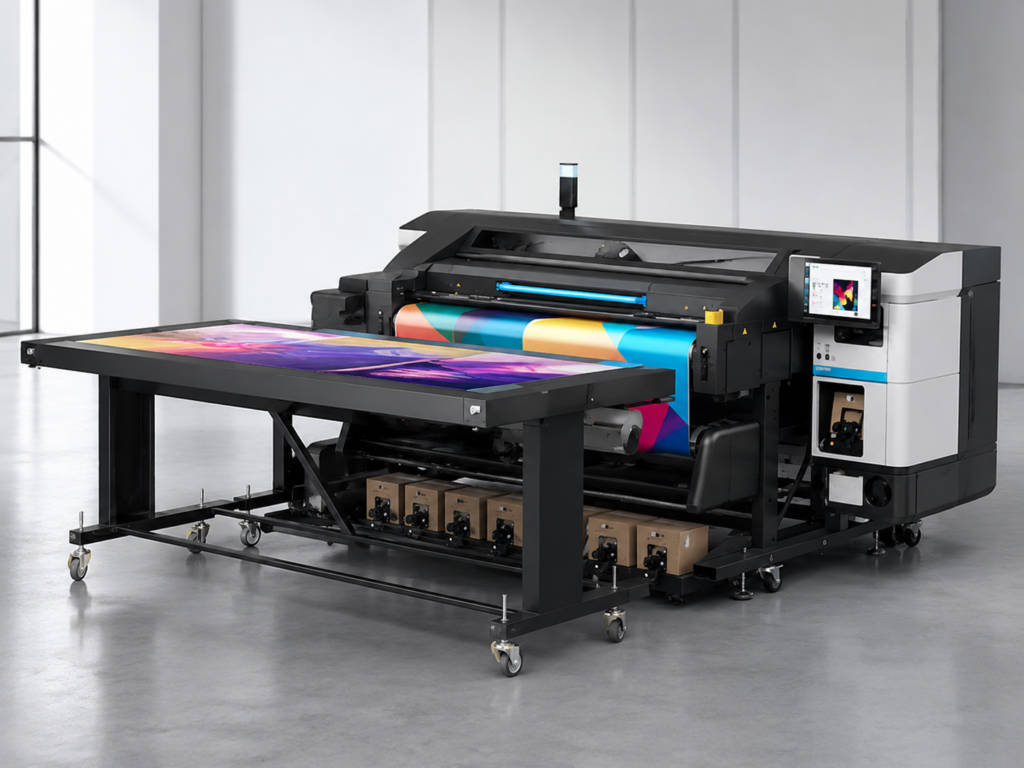
- Direct-to-board printing. The HP Latex R530 is HP’s 64-inch hybrid successor in this class. It handles rigid board and roll media on one footprint, runs on single-phase power, and uses water-based latex ink instead of UV-curable ink, so prints come off the machine dry and ready to finish. White ink is available, which opens up backlit, clear, and dark-substrate work that the FB550 could not produce.
- Roll-to-roll production. The HP Latex 700 and 800 series are the current production roll-to-roll platforms and are HP’s stated path forward from the Latex 570.
- Finishing. A shop cutting 2,000 rigid sheets a year should look at a flatbed cutter rather than a manual trimmer. Contour cutting on rigid board is where most in-house shops lose their productivity gain back.
- Ink and media. Latex ink is water-based and prints dry, which is why it works in a warehouse or office-adjacent environment without dedicated ventilation.
- White ink applications. If your program includes window graphics, cooler door decals, or printing on clear and colored substrates, white ink capability is worth specifying up front.
Model availability, configurations, and pricing change. Confirm current specifications and pricing with a Big Systems specialist before you build a budget.
Is beverage distributor flatbed printing right for your operation
Beverage distributor flatbed printing is one case of a broader pattern. The Buck story translates to any organization producing high volumes of rigid signage for its own accounts or locations: beverage and food distributors, grocery and convenience chains, dealership groups, school districts, manufacturers, municipalities, and corporate print rooms.
Work through these before you quote equipment.
- Volume of rigid signage. Count annual sheet consumption of coroplast, foam board, styrene, PVC, or gator board. Buck ran roughly 2,000 sheets of 4 x 8 per year. Several hundred or more is worth modeling.
- Share of work that requires mounting. If most of your output is printed on vinyl and mounted to board, you pay for vinyl, laminate, and labor on every unit. That is the fastest payback here.
- Labor you can redeploy. Buck eliminated a dedicated mounting position. Check whether yours is a headcount, an overtime line, or an outsourced service.
- Turnaround pressure. If sales loses opportunities to a three or four day wait, speed carries revenue value beyond the cost savings.
- Outsourced spend. Total what you send to outside vendors for rigid signage each year, then compare it against equipment payment, ink, board, and operator time.
- Space and power. A 64-inch hybrid needs floor space, table clearance when running rigid, and appropriate power. A site review avoids install surprises.
- Operator plan. One trained operator beats three people learning casually. Factor in installation and training.
To model beverage distributor flatbed printing against your current workflow: multiply annual sheet volume by your current all-in cost per sheet, including vinyl, laminate, and mounting labor. Compare that against projected direct-to-board cost per sheet plus the monthly equipment payment. If rigid volume is steady and mounting is a real labor line, the math resolves faster than most buyers expect. We will build that comparison with your numbers.
Why Buck chose Big Systems
When Buck decided to add flatbed capability, the company came to Big Systems for guidance on the machine, the workflow, and the media. Big Systems has supported beverage distributors and in-house sign shops nationwide for decades, which means the recommendation came from people who had seen the print-and-mount problem before.
“Big Systems has improved the quality of our work, productivity, and all the time keeping our costs down. Even though they are located in Wisconsin, I’ve always felt Big Systems was a local business.”
“We trust Big Systems. We’ve made changes based on their recommendations that keep us in the forefront of beer signage in our area. The service has been great, their products are very competitive, and I’m looking forward to doing business with them for a long time.”
— Mark Jones, Buck Distributing
That is the part of an equipment decision that does not appear on a spec sheet. Beverage distributor flatbed printing depends on more than print speed, ink, and media compatibility. A distributor’s sign shop is not a print business and typically does not have a dedicated service department or color specialist on staff. When a printhead fails on a Thursday and 300 sign requests are queued, the value of the relationship is measured in hours of downtime.
Talk through your own signage workflow
If you produce rigid signage in-house, or you are paying an outside vendor to do it, we can help you If you produce rigid signage in-house, or you are paying an outside vendor to do it, we can help you model the cost per sheet, match the right hybrid or flatbed printer to your volume, and plan the finishing side so the productivity gain holds. That is the whole scope of a beverage distributor flatbed printing decision, and none of it should be guesswork.
Contact a Big Systems specialist or schedule an equipment demo to see direct-to-board printing on your own substrates. You can also review financing options if you are comparing an equipment payment against current outsourced or labor costs.
Big Systems LLC · N59W14053 Bobolink Ave, Menomonee Falls, WI 53051 · 888-244-4177 · bigsystems.com
Frequently asked questions
Direct-to-board printing means printing straight onto a rigid substrate such as corrugated plastic, foam board, styrene, PVC, or gator board using a flatbed or hybrid printer. It replaces printing on adhesive vinyl and mounting it to board, removing the vinyl, laminate, and mounting labor.
Yes. Flatbed and hybrid wide-format printers print directly onto corrugated plastic sheets, including 4 x 8 foot sheets, and can print both sides for double-sided signage. It is one of the most common applications for in-house shops producing point-of-purchase and yard signage.
Buck Distributing reported approximately six minutes per 4 x 8 foot sheet on its HP FB550. Actual speed depends on the machine, the print mode, and the resolution selected. Current hybrid printers such as the HP Latex R530 publish higher rated throughput.
A true flatbed prints only rigid sheets on a fixed table. A hybrid printer prints rigid sheets and can also run roll media by removing or lowering the tables. Hybrids are usually the better fit for an in-house shop because one machine covers boards, banners, posters, and window graphics.
In Buck Distributing’s experience, double-sided printed coroplast signs with grommets lasted longer in service than vinyl banners and needed replacement less often. Actual durability depends on ink, substrate, whether the print is laminated, and the installation environment.
HP’s current 64-inch hybrid printer in this class is the HP Latex R530, which prints rigid and flexible media, runs on single-phase power, and offers white ink. Confirm current configurations with a Big Systems specialist.
Verification notes
All performance figures, production volumes, turnaround times, and quotes in this document are as reported by Buck Distributing and reflect that company’s own operating results. Results vary by application, substrate, print mode, staffing, and workflow. Equipment models, specifications, availability, and pricing change over time. Confirm current details with a Big Systems specialist before making a purchasing decision.
